SOC Analyst vs Ethical Hacker: Which Career Is Better?
SOC Analyst vs Ethical Hacker: Compare roles, skills, career paths, salaries, certifications and job opportunities to choose the right cybersecurity career.
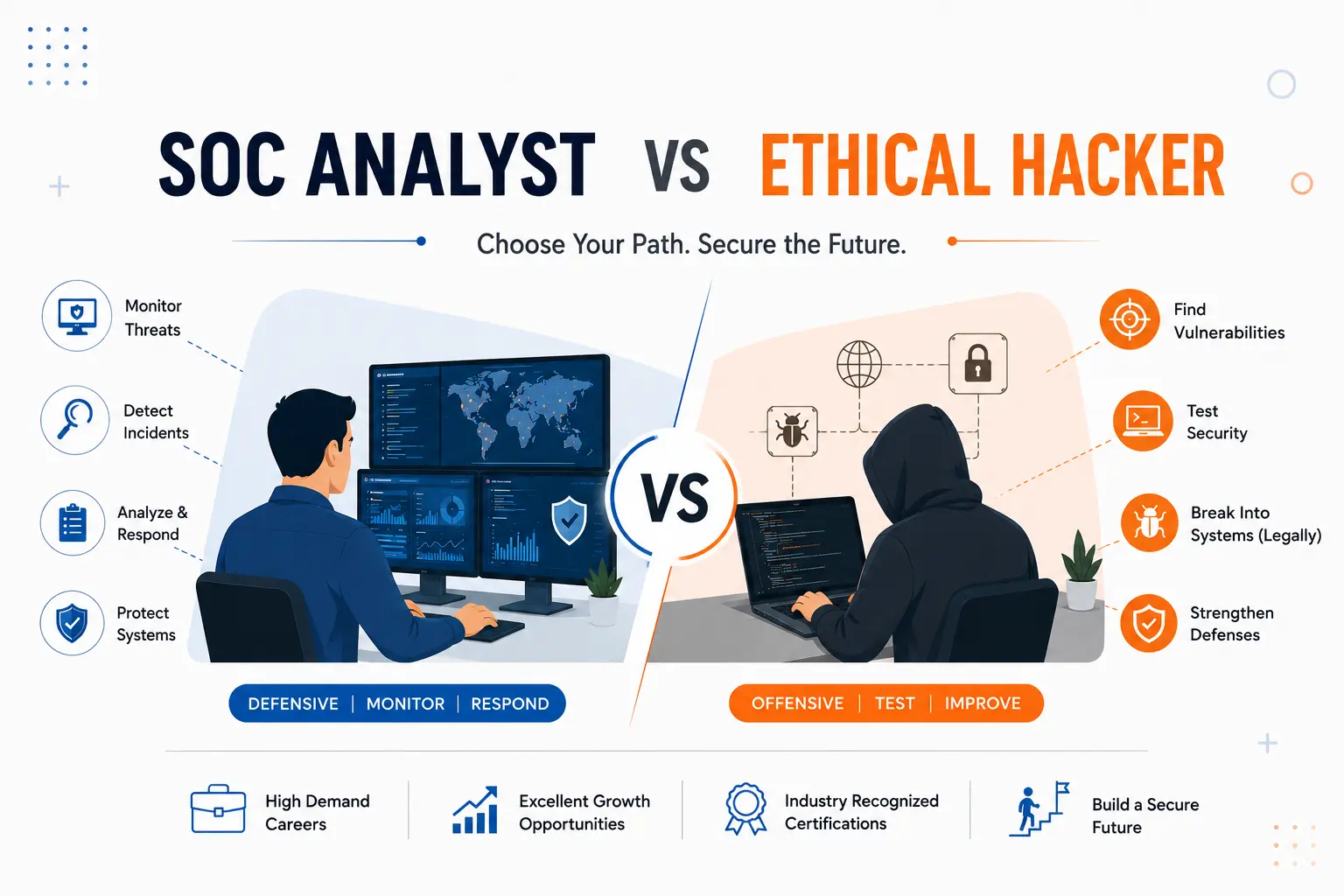
SOC Analyst vs Ethical Hacker: Which Career Is Better?
SOC Analyst vs Ethical Hacker: Compare roles, skills, career paths, salaries, certifications and job opportunities to choose the right cybersecurity career.
The cybersecurity industry offers a wide range of career opportunities, but two roles often stand out for aspiring professionals: SOC Analyst and Ethical Hacker. Both careers play an important role in protecting organizations from cyber threats, but their responsibilities, skills, work environments, and career paths are quite different.
If you are planning to build a career in cybersecurity, one common question is: SOC Analyst vs Ethical Hacker, which career is better?
Join Webinar about
Practical Training & Job-Oriented Courses
Apply for Upcoming Training Intake
The answer depends on your interests, skills, and long-term career goals. This guide compares both roles in detail to help you choose the right cybersecurity career path.
What Is a SOC Analyst?
A Security Operations Center (SOC) Analyst is responsible for monitoring, detecting, analyzing, and responding to potential cybersecurity threats.
SOC Analysts work with security monitoring systems and investigate suspicious activities across an organization's networks, endpoints, applications, and IT infrastructure.
Their primary goal is to identify potential attacks as early as possible and help protect the organization from security incidents.
Key Responsibilities of a SOC Analyst:
A SOC Analyst may be responsible for:
- Monitoring security alerts and events
- Analyzing suspicious network activity
- Investigating potential security incidents
- Working with SIEM tools
- Identifying malware and phishing attempts
- Escalating critical security incidents
- Supporting incident response activities
- Documenting security findings
- Monitoring vulnerabilities and threats
A SOC Analyst role is often considered one of the best entry points for professionals starting a career in cybersecurity.
What Is an Ethical Hacker?
An Ethical Hacker, also known as a penetration tester in many organizations, is a cybersecurity professional who legally identifies vulnerabilities before malicious attackers can exploit them.
Ethical Hackers think from an attacker's perspective. They test systems, networks, applications, and infrastructure to discover security weaknesses and recommend solutions.
Unlike cybercriminals, Ethical Hackers perform testing with proper authorization and within a defined scope.
Key Responsibilities of an Ethical Hacker:
An Ethical Hacker may:
- Perform vulnerability assessments
- Conduct penetration testing
- Test web applications and networks
- Identify security vulnerabilities
- Analyze misconfigurations
- Perform reconnaissance and information gathering
- Test authentication and access controls
- Prepare vulnerability reports
- Recommend security improvements
Ethical hacking is ideal for professionals who enjoy technical problem-solving, security testing, and understanding how cyberattacks work.
SOC Analyst vs Ethical Hacker: Key Difference
|
Factor |
SOC Analyst |
Ethical Hacker |
|
Primary Focus |
Detecting and responding to threats |
Finding vulnerabilities before attackers do |
|
Work Approach |
Defensive security |
Offensive security |
|
Main Goal |
Monitor and protect systems |
Test and improve security |
|
Daily Activities |
Alert monitoring and incident analysis |
Security testing and vulnerability assessment |
|
Common Tools |
SIEM, EDR, Splunk, Sentinel |
Nmap, Burp Suite, Metasploit, Kali Linux |
|
Entry Level |
Often beginner-friendly |
Usually requires strong technical fundamentals |
|
Career Path |
SOC → Security Analyst → Incident Response → Security Engineer |
Ethical Hacker → Penetration Tester → Red Team → Security Consultant |
|
Key Skills |
Monitoring, analysis, incident response |
Networking, Linux, penetration testing |
|
Work Style |
Continuous monitoring and investigation |
Project-based security testing |
Both roles are valuable, and neither is universally "better." The right choice depends on what type of cybersecurity work interests you most.
SOC Analyst Career Path
A SOC Analyst career typically begins with strong cybersecurity fundamentals.
Step 1: Learn IT and Networking Basics
Start by understanding:
- Computer networks
- TCP/IP
- Ports and protocols
- DNS
- HTTP and HTTPS
- Firewalls
- Operating systems
- Windows and Linux basics
Networking knowledge is essential because many cyber incidents involve network communication and unusual traffic patterns.
Step 2: Learn Cybersecurity Fundamentals
Build knowledge of:
- Common cyber threats
- Malware
- Phishing
- Ransomware
- Vulnerability management
- Authentication and access control
- Security policies
- Incident response
Step 3: Learn Security Monitoring Tools
SOC Analysts commonly work with:
- SIEM platforms
- EDR and XDR tools
- Log management tools
- Threat intelligence platforms
Learning how to analyze logs and investigate alerts can help you prepare for an entry-level SOC Analyst role.
Step 4: Practice Incident Investigation
Hands-on practice is important. Learn how to:
- Analyze suspicious login attempts
- Investigate phishing emails
- Review security logs
- Identify indicators of compromise
- Understand attack techniques
Step 5: Earn Relevant Certifications
Depending on your experience and career goals, certifications can help validate your knowledge.
Popular options include cybersecurity foundation and security operations certifications. Professionals can later specialize further in incident response, threat hunting, cloud security, or security engineering.
Ethical Hacker Career Path
An Ethical Hacker requires a strong understanding of how systems work before learning how to test their security.
Step 1: Master Networking Fundamentals
Learn:
- TCP/IP
- OSI model
- DNS
- HTTP/HTTPS
- IP addressing
- Ports and protocols
- Routing and switching
Step 2: Learn Linux and Operating Systems
Linux is widely used in cybersecurity and penetration testing environments.
Important areas include:
- Linux commands
- File permissions
- User management
- Processes
- Networking commands
- Bash basics
You should also understand Windows fundamentals because many enterprise environments use Windows-based infrastructure.
Step 3: Learn Cybersecurity Fundamentals
Before performing penetration testing, understand:
- Vulnerabilities
- Attack vectors
- Authentication
- Encryption
- Web security
- Network security
- Common cyberattacks
Step 4: Learn Ethical Hacking and Penetration Testing
Develop practical skills in areas such as:
- Reconnaissance
- Vulnerability assessment
- Web application testing
- Network security testing
- Password security testing
- Reporting vulnerabilities
Step 5: Practice in Safe Lab Environments
Hands-on labs are essential for building ethical hacking skills. Always practice only in authorized and legal environments.
Step 6: Pursue Professional Certifications
Certifications such as CEH (Certified Ethical Hacker) can help professionals gain structured knowledge of ethical hacking concepts and cybersecurity practices.
Skills Required for a SOC Analyst
To become a successful SOC Analyst, focus on the following skills:
Technical Skills
-
Networking fundamentals
- Linux and Windows basics
- SIEM monitoring
- Log analysis
- Threat detection
- Incident response
- Malware basics
- Threat intelligence
- Vulnerability management
Soft Skills
-
Analytical thinking
- Attention to detail
- Communication
- Documentation
- Problem-solving
- Ability to work under pressure
A SOC Analyst needs to quickly analyze large amounts of information and determine whether an alert represents a genuine security threat.
Skills Required for an Ethical Hacker
Ethical Hackers need a more attack-focused technical skill set.
Important Technical Skills
-
Networking
- Linux
- Web technologies
- Python or scripting basics
- Vulnerability assessment
- Penetration testing
- Web application security
- Network security
- Security tools
Important Soft Skills
-
Curiosity
- Problem-solving
- Persistence
- Analytical thinking
- Report writing
- Attention to detail
Ethical Hackers must understand both technology and potential attack methods to identify security weaknesses effectively.
SOC Analyst vs Ethical Hacker Salary in India
Cybersecurity salaries can vary significantly depending on experience, location, technical skills, certifications, company size, and job responsibilities.
SOC Analyst Salary
Entry-level SOC Analysts may start with salaries in a moderate range, while experienced professionals who specialize in threat hunting, incident response, cloud security, or security engineering can progress to significantly higher packages.
Ethical Hacker Salary
Ethical Hackers and penetration testers with strong hands-on skills may also earn competitive salaries. Professionals with experience in advanced penetration testing, red teaming, application security, or security consulting can access higher-level opportunities.
Important: Instead of choosing a career only based on salary, focus on developing practical skills. Strong cybersecurity skills and relevant experience often have a greater impact on career growth over time.
Which Career Is Easier for Beginners?
For many beginners, a SOC Analyst career path can be easier to enter because it provides exposure to real-world security monitoring, alerts, logs, and incident handling.
However, this does not mean the role is easy. SOC Analysts need strong analytical skills and must understand how different cyber threats work.
Ethical Hacking can also be a suitable career path for beginners, but it often requires deeper technical knowledge of networking, Linux, systems, web applications, and security testing.
Choose SOC Analyst If You Enjoy:
-
Investigating security alerts
- Monitoring systems
- Analyzing logs
- Detecting cyber threats
- Incident response
- Defensive cybersecurity
Choose Ethical Hacking If You Enjoy:
-
Finding vulnerabilities
- Testing systems
- Understanding attack techniques
- Solving technical challenges
- Penetration testing
- Offensive cybersecurity
SOC Analyst vs Ethical Hacker: Which Has Better Career Growth?
Both careers offer excellent growth opportunities.
SOC Analyst Career Growth
A SOC Analyst can progress into roles such as:
SOC Analyst → Security Analyst → Threat Hunter → Incident Response Analyst → Security Engineer → Security Architect
Professionals can also specialize in cloud security, digital forensics, threat intelligence, or security operations.
Ethical Hacker Career Growth
An Ethical Hacker can progress into roles such as:
Ethical Hacker → Penetration Tester → Senior Penetration Tester → Red Team Specialist → Security Consultant → Security Architect
Ethical Hackers may also specialize in web application security, cloud penetration testing, red teaming, or application security.
SOC Analyst vs Ethical Hacker: Which Certification Should You Choose?
The right certification depends on your chosen career path.
If your goal is to build a strong foundation in cybersecurity and move toward offensive security, a certification such as CEH can help you understand ethical hacking methodologies and security concepts.
For a SOC-focused career, cybersecurity fundamentals, security operations knowledge, log analysis, and hands-on experience with monitoring tools are particularly valuable.
The most important factor is not collecting multiple certifications. Focus on building a combination of:
Strong fundamentals + Practical skills + Relevant certification + Hands-on projects
How VigyantHub Can Help You Start Your Cybersecurity Career
Building a successful cybersecurity career requires more than theoretical knowledge. Employers increasingly look for professionals who understand how security concepts work in practical environments.
At VigyantHub, cybersecurity learning can be approached with a focus on building industry-relevant knowledge and practical skills. Through structured training, learners can strengthen their understanding of cybersecurity concepts, ethical hacking, tools, and real-world security challenges.
A structured learning approach can help you:
- Build strong cybersecurity fundamentals
- Understand networking and security concepts
- Develop practical skills through hands-on learning
- Prepare for cybersecurity certifications
- Learn from experienced professionals
- Build confidence for technical interviews
- Create a clearer cybersecurity career roadmap
For professionals interested in ethical hacking, CEH-focused training and hands-on cybersecurity learning can provide a structured path toward developing relevant skills.
SOC Analyst vs Ethical Hacker: Which Career Is Better for You?
There is no single answer because both careers serve different purposes.
SOC Analysts protect organizations by detecting and responding to threats.
Ethical Hackers improve security by identifying vulnerabilities before malicious attackers can exploit them.
If you enjoy analyzing security events, monitoring threats, and responding to incidents, a SOC Analyst career may be the right choice.
If you enjoy exploring systems, identifying weaknesses, and performing security testing, Ethical Hacking may be a better fit.
You can also start in one area and move into another as your cybersecurity career develops. The skills learned in SOC operations, networking, threat analysis, and cybersecurity fundamentals can be valuable across multiple security roles.
Final Thoughts
The debate around SOC Analyst vs Ethical Hacker is not about which role is better for everyone. It is about choosing the career path that matches your interests and strengths.
A SOC Analyst focuses primarily on the defensive side of cybersecurity, monitoring systems and responding to potential threats. An Ethical Hacker takes an authorized offensive approach, identifying vulnerabilities and testing an organization's security.
Both roles offer strong career opportunities for professionals willing to continuously learn and develop practical cybersecurity skills.
Start with the fundamentals, build hands-on experience, choose a specialization, and continue upgrading your knowledge. Whether you choose a SOC Analyst career or Ethical Hacking, the right training and practical exposure can help you build a strong foundation for long-term success in cybersecurity.
With industry-focused learning and practical training from VigyantHub, you can take the next step toward building the cybersecurity career that best matches your goals.

Insights That Shape Better Careers
Modern industries value adaptability, problem-solving, and hands-on experience. Structured learning plays a key role in professional growth.
SOC Analyst vs Ethical Hacker: Which Career Is Better? FAQs
Frequently Asked Questions
Welcome back
Our Professional Trending Courses
The most popular picks by professionals, for professionals.
Microsoft Azure Administrator (AZ-104)
Master the skills required to implement, manage, and monitor identity,...
EC-Council Certified Ethical Hacker v13 (CEH v13) Training
The CEH v13 course equips cybersecurity professionals with hands-on skills...

Project Management Professional (PMP)® Training
Master the project management skills required to lead complex projects...

AWS Solution Architect Associate (SAA-C03)
Elevate your career by mastering the ability to design resilient,...